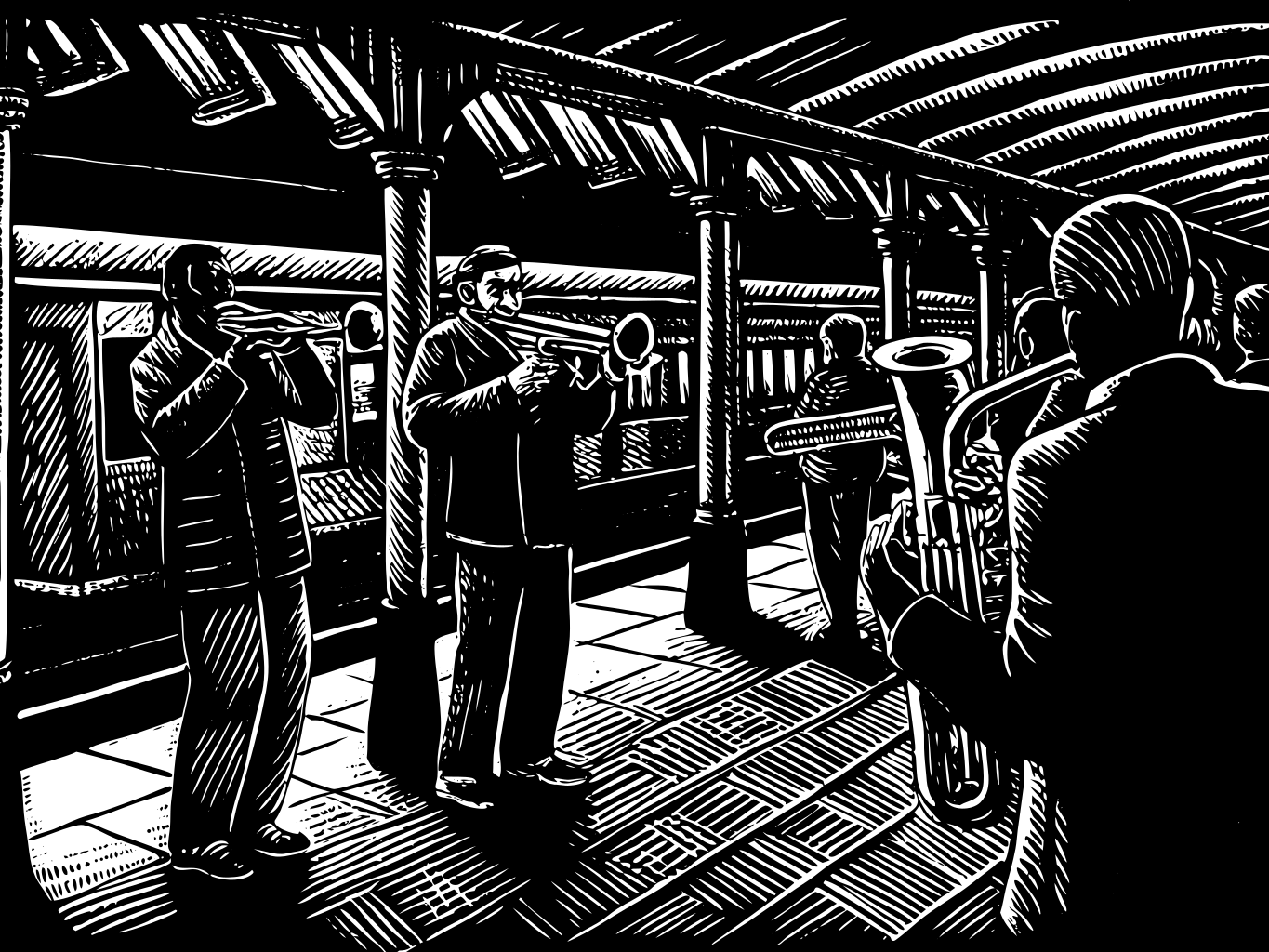
The performers at Times Square–42 St are there legally — almost all of them. Two overlapping systems govern who plays the mezzanine, and most riders know neither.
The performers at Times Square–42 St aren't squatting, and there's no 3 a.m. scramble for the corner near the vinyl store. Two different systems govern who makes music in that mezzanine — and most daily riders don't know either one.
Under Section 1050.6(c) of the NYC Transit Rules of Conduct, any musician may perform in a subway mezzanine without a permit, provided they don't block passenger flow and don't charge admission (accepting donations is explicitly allowed). That rule has been on the books since 1985, when a court challenge by musician Roger Manning overturned the MTA's longstanding performance ban. The agency codified it that year, and the legal baseline hasn't changed since.
On top of that sits MTA Music — the authority's formal busking program, officially rebranded from "Music Under New York" (MUNY) earlier this year by MTA Arts & Design. The program carries more than 150 performers and ensembles, selected through an audition process: an application followed by a live session before a jury panel. The current roster puts on more than 8,500 performances annually across roughly 30 high-traffic stations, plus the LIRR, Metro-North, and the Staten Island Ferry.
Times Square–42 St has two designated MTA Music spots on the agency's published location list: the small mezzanine near 41 St and the upper-level main entrance. Performers who auditioned for those slots get priority scheduling — MTA Music assigns times in advance. A freelance musician who shows up without a program affiliation can legally take any other available mezzanine space that isn't reserved, as long as they follow the same rules.
Those rules apply to everyone, affiliated or not: no amplification on platforms; no playing within 25 feet of a station booth or fare machine; sound cannot exceed 85 decibels (A-weighted) at five feet from the source; nothing that impedes passenger movement. Access to commuter rail terminals — Grand Central, Penn Station, Atlantic Terminal — is limited to MTA Music members.
The program currently has no new auditions scheduled; the MTA says it will announce future opportunities at mta.info. The 2026 rebrand also introduced a "Stations Series" — monthly themed performances at one location per borough — with July's slate pegged to the Great American Songbook in conjunction with the America 250 commemoration.
The practical answer to who gets that corner spot at 7 a.m.: the MTA Music performer whose name is on the schedule. Everyone else shows up when they show up.
