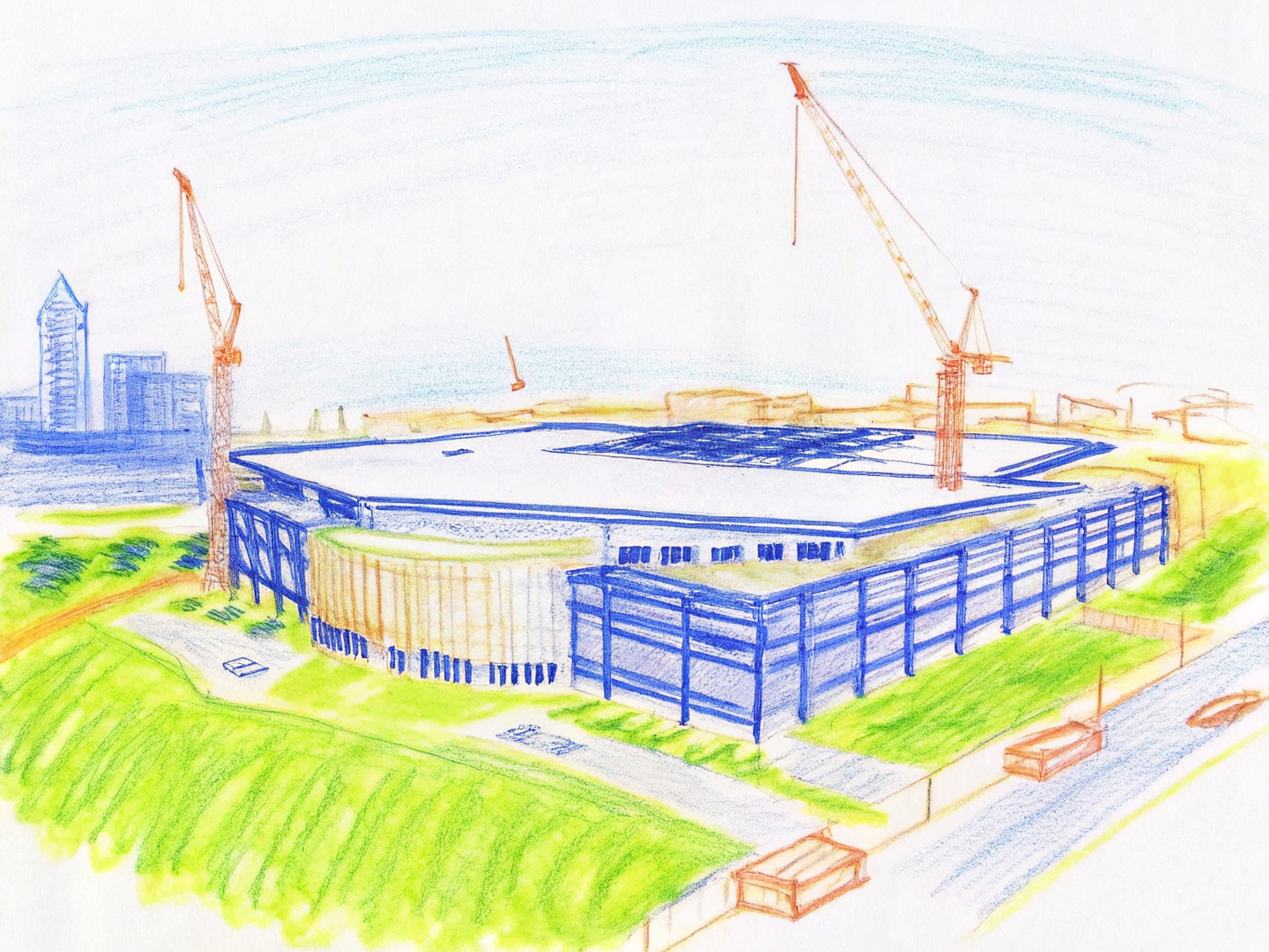
The Giants are adding 93,500 square feet of new construction and renovating 46,000 more at the Quest Diagnostics Training Center — designed by EwingCole, the same architects who built the original 2009 facility. Cryotherapy chambers, hyperbaric rooms, and a tripled sports medicine footprint arrive before the 2028 season. Harbaugh's first two years happen in the building under construction.
The New York Giants announced plans Monday to add 93,500 square feet of new construction and renovate 46,000 more at the Quest Diagnostics Training Center in East Rutherford — a project designed by EwingCole and built by Natoli Construction Corp., targeting completion before the 2028 NFL season. No cost was disclosed. The centerpiece amenities: a locker room exceeding 6,000 square feet with 100 full-size lockers, an 11,000-square-foot weight room with a nutrition bar and a cardio mezzanine overlooking the indoor field, a sports medicine and rehabilitation suite that triples the current footprint, and a recovery wing running the full modern catalog — hydrotherapy pools, steam, sauna, red light therapy, cryotherapy chambers, dry float tanks, and hyperbaric chambers.
That last list tells you something important about when the building being expanded was built. EwingCole designed the original Quest Diagnostics Training Center in 2009 — a 194,000-square-foot complex constructed after the demolition of Giants Stadium, when 1925 Giants Drive was a blank canvas. At the time, Mara called it "a facility that will meet our needs for years to come." Seventeen years later, those needs have outgrown the building. The amenities in Monday's announcement — cryotherapy, hyperbaric chambers, dry float tanks — are the vocabulary of a different era in athlete performance and recovery; they didn't exist as standard NFL practice-facility infrastructure when Tom Coughlin was running two-a-days on the same site.
"This is a significant investment in the future of our football operation," Mara said in Monday's release. "As the game continues to evolve, we must continue to evolve with it."
The timing is deliberate even if it isn't loud about it. The Giants have dropped three straight losing seasons. They hired John Harbaugh this spring, traded Dexter Lawrence to Cincinnati for the 10th pick, then used the 5th overall on Ohio State edge Arvell Reese. They're holding training camp at The Greenbrier resort in West Virginia right now — partly because the cafeteria at 1925 Giants Drive was already being gutted and rebuilt, a smaller renovation that finished this spring and served as a kind of down payment on Monday's bigger announcement.
Treasurer Jonathan Tisch framed the design in organizational terms: "Every design decision was made with purpose — from how players move through the building to how a team connects and collaborates."
The practical translation matters more than the architectural language. A football front office in 2026 knows that player retention and free-agent recruiting — including the informal word-of-mouth that runs through agents — is partly a facilities competition. A practice building sends a message before a coach says a word. The Giants' current building has done its job for 17 years. What they're building now is a statement about what they expect the next 17 to look like.
The 2028 deadline means rookies signed in the 2026 draft will spend their first two years in a facility that's simultaneously a construction site and their professional home. For a team asking a young roster to buy into a rebuild under a new coaching staff, that's the sort of unglamorous institutional detail that either breeds resilience or breeds the exits that fill the rumor cycle. Two seasons is a long time to ask people to bet on blueprints.
The project is a statement. Whether it becomes a signal of sustained competitiveness or a very expensive consolation prize depends on what happens on the field between now and the ribbon-cutting.
